
Jo's AML story
When Jo was diagnosed with acute myeloid leukaemia (AML), she had no idea whether she would survive. After her leukaemia returned, an anonymous stem cell donor gave her a second chance at life. Two years later, they finally met and have since become friends.
07 Oct 2026
Their story in brief
Family has always been at the centre of my world.
I’m married with two children and spent much of my career working as a mental health nurse in the NHS. Outside work, I love reading, creative writing, music and cooking.
I’m definitely a feeder. Nobody crosses the threshold of our house without being offered cake.
Towards the end of 2022, though, I started noticing changes in my health.
I was tired more often, I was sweating and I was becoming increasingly unfit.
At the time, I was 50 and taking HRT, and there was so much discussion about menopause symptoms that I assumed that must be the explanation.
It was like, of course it’s the menopause. Everyone was talking about it.
I contacted my GP about changing or increasing my HRT, but I carried on feeling unwell.
At the beginning of 2023, I decided I needed to get fitter and joined a gym.
That was when I realised quite how weak I had become.
During one group session, I tried to get into a plank and I simply couldn’t lift myself off the floor.
I was just so weak.
I left the gym and walked home thinking, “Oh my God, I’ve got no stamina.”
When I got home, I went to bed and slept for the whole afternoon.
By then, I was also experiencing joint pain, a persistent cough and increasing exhaustion.
A few weeks later, I was taking my daughter to Cornwall when I became so unwell that my husband had to drive all the way from Nottingham to collect me.
I’d hoped that by the time he arrived I might feel well enough to go for breakfast at one of my favourite cafés.
Instead, I couldn’t even get off the sofa.
That was when I thought, “You know what? This isn’t right.”
It wasn’t the menopause. It wasn’t an infection that just wouldn’t go away.
By then, even walking upstairs to collect the laundry left me exhausted and breathless. I had developed stomach pain and had lost my appetite too.
I went back to my GP, who arranged blood tests and further investigations.
Within days, I was told that I needed to speak to haematology and was asked to go into hospital straight away.
The next day, I had a bone marrow biopsy.
That afternoon, I was told I had acute myeloid leukaemia, or AML.
Everything moved incredibly quickly.
By the Friday, I had started treatment.
The doctor told me that if I hadn’t come into hospital when I did, I might only have had weeks to live.
I spent the following months having intensive chemotherapy and eventually reached remission.
Then the leukaemia came back.
In some ways, hearing that was worse than the original diagnosis because I’d gone through all that treatment and it hadn’t worked.
This time, doctors told me I would need a stem cell transplant.
My brother was tested, but unfortunately he wasn’t a match, so the search began for an unrelated donor.
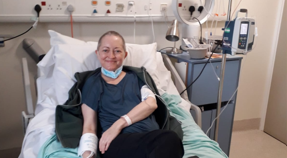
In the meantime, I had salvage chemotherapy and spent seven weeks in hospital.
I missed Christmas with my family.
The treatment put me back into remission, but I still needed that stem cell donor.
Then they found a match.
On 28 March 2024, I received a stem cell transplant from somebody I knew nothing about.
His name was Harry.
At the time, though, he was completely anonymous to me.
For the next two years, we were able to exchange anonymous letters through Anthony Nolan.
I knew there was somebody out there who had done this extraordinary thing for me, but I didn’t know who he was.
Eventually, we were given the opportunity to exchange our details.
Harry agreed.
A few weeks later, we met for the first time.
I ran towards him and gave him a huge hug.
It’s difficult to put into words what meeting him meant.
Harry didn’t just give me stem cells. He gave me the chance to be there for my children.
He gave me the chance to help my daughter choose her prom dress, to support my children through their exams and to sit around the Christmas dinner table with my family.
He meant that my children didn’t have an empty chair at Christmas.
My parents didn’t lose their daughter.
All those things I’d imagined telling him while I was ill, I finally got to say to him.
It was incredible.
We’ve become friends now, which makes the whole thing even more special.
Going through AML and a stem cell transplant has completely changed my perspective on life.
I’ve had sepsis. I’ve spent time in critical care. I’ve been through treatment that was hideous.
I’ve also had to genuinely contemplate my own death and what that would mean for my family.
I feel like I’ve come out the other side.
But I haven’t come out of it thinking I need to climb mountains or complete a huge bucket list.
The things I value now are much smaller.
Sitting on the sofa with my daughter.
Running my hands through my son’s hair.
Making brownies when his friends come round.
Cooking dinner.
Doing the laundry.
Waking up and hearing the birds singing.
When you stare death in the face, you don’t necessarily think, “I wish I’d gone to Machu Picchu.”
I just wanted to be with my family, doing all the ordinary things that make up our lives.
Looking back at the months before I was diagnosed, one of the biggest things that stays with me is how easily I explained my symptoms away.
I just kept thinking it was the menopause.
There was always another explanation for why I might be tired, sweaty, weak or generally unwell.
That’s why I think it’s so important to pay attention when something doesn’t feel right, particularly when symptoms persist or several different things start happening at the same time.
You know your own body.
If you feel that something has changed and it isn’t getting better, speak to your GP and keep asking questions.
I’m incredibly grateful that I eventually got the answers I needed.
And I will always be grateful to the stranger who decided to join the stem cell register, donated his cells and gave me the chance to still be here with my family.
That stranger is Harry.
And now he’s my friend.
Want to share your story?
Your experience could help others going through a similar journey.
Get in Touch