
Dan's AML Story
Fit, active and just 33, Dan had always considered himself one of the last people who would become seriously ill. But when flu-like symptoms persisted and his temperature repeatedly reached 40°C, he trusted his instincts and went to hospital. Within hours, his life had changed completely.
07 Oct 2026
Their story in brief
I’ve always been active. I’m a former member of the Royal Navy, I work as a mechanical engineer and running, cycling and going to the gym have always been a big part of my life.
So when I started feeling unwell in September 2025, I didn’t immediately think it could be anything serious.
I just felt a bit flu-like. I thought I’d picked up a summer cold or a virus. Everyone gets them, especially when you’ve been travelling around and picking things up.
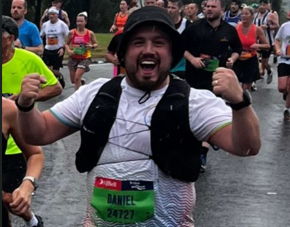
At the time, I was also preparing for the Great North Run. I’d completed it for five consecutive years and had raised money for various leukaemia charities along the way.
But around three miles into the race, I knew something wasn’t right.
Normally, I would set off and my friend would struggle to keep up with me, but this time I just didn’t feel right. I still thought it was the flu, so I carried on and finished the race.
I completed the 13.1 miles in 2 hours and 21 minutes, which was around half an hour slower than my usual time.
When I met my wife afterwards, she just looked at me and said, “You don’t look well.”
Over the next few days, I became increasingly unwell. My temperature kept climbing to between 39°C and 40°C. I had very little appetite and was completely exhausted.
I went to my GP several times and was initially told it looked like a viral infection.
I’ve always been quite stubborn when it comes to doctors. I was only 33, I was fit and healthy, and I thought there couldn’t really be anything seriously wrong with me.
But deep down, I had that feeling that something wasn’t right.
After several days of high temperatures and continuing to feel worse, I went to A&E at my local hospital.
Blood tests showed that my blood counts were extremely low. I had virtually no neutrophils or white blood cells to fight infection.
I was admitted overnight and told a haematologist would come to see me the following morning.
The next day, doctors explained that they were concerned there might be a problem with my bone marrow and that it could be leukaemia.
I didn’t really know what any of it meant at that point.
Then they told me they thought I had acute myeloid leukaemia, or AML.
That was a bit of a pill to swallow.
I was transferred to the Freeman Hospital in Newcastle, where I had a bone marrow biopsy. On 14 October 2025, my diagnosis of AML was confirmed.
It all happened so quickly. I went from thinking I had a cold or a virus to suddenly being told I had leukaemia.
But from the moment I arrived at the Freeman, the staff were fantastic. They became like a second family.
I started chemotherapy that same night.
Initially, the plan was for me to have three rounds of chemotherapy. But within days, further tests showed that my AML was aggressive and that chemotherapy alone was unlikely to be enough.
I was told I would need chemotherapy, radiotherapy and then a stem cell transplant.
My brother was tested to see whether he could donate stem cells and, fortunately, he was a full match.
He donated his stem cells at the end of January and, on 4 February 2026, I received my transplant.
The recovery afterwards has been a gradual process.
After spending months in hospital and in isolation, even normal everyday things felt difficult when I first came home.
There were times when I needed help getting in and out of the shower. You don’t think about things like that when you’re young and fit.
I’ve been incredibly thankful for my wife, my family and the support network around me.
I’m not back to running or cycling yet, but I’m slowly rebuilding my strength.
I go out walking, keep an eye on my daily steps and use light weights. I’m taking everything one day at a time.
Leukaemia Care has also supported me throughout my experience.
Jacqui, one of Leukaemia Care’s hospital navigators in Newcastle, has been fantastic. She’s checked in on me when she’s seen me in hospital, but she’s also checked in with my wife.
That emotional and mental support has meant a lot to both of us.
I also now attend a support group, where I’ve met people who have been living cancer-free for 10 or even 20 years.
Seeing people who have been through it and are still doing well gives you hope.
It gives you that drive to keep going, keep healthy and get stronger.
Going through AML has completely changed the way I think about my own health.
I’ve always thought of myself as a really strong, fit lad, but being fit and healthy doesn’t mean you should ignore what your body is telling you.
You’ve got to be aware of yourself and listen to your body.
When I was in hospital, I lived one day at a time, and I think that’s something everyone can take into everyday life.
You just have to concentrate on what you’re doing that day.
Looking back, the first signs of my leukaemia didn’t feel dramatic. They felt like the kind of illness anyone could pick up.
I thought I had flu.
I never imagined it could be leukaemia.
Want to share your story?
Your experience could help others going through a similar journey.
Get in Touch