
Rowan's APL story
After weeks of worsening symptoms including extreme tiredness, unexplained bruising and unusual bleeding, Rowan was diagnosed with acute promyelocytic leukaemia (APL) at just 27. Now in remission, she wants other young people to know that leukaemia can affect anyone, at any age, and that persistent or unusual symptoms should always be checked.
07 Oct 2026 - Leukaemia Care
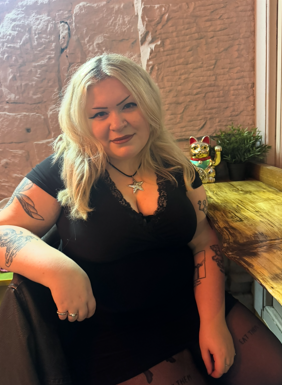
Their story in brief
Before I was diagnosed, I considered myself a relatively healthy young person. I’m originally from Edinburgh but had moved to Glasgow to do a master’s degree in creative writing. I was working from home in customer service alongside pursuing my writing.
In February 2025, I started feeling really run down and developed a particularly bad sore throat. I went to my GP and was diagnosed with tonsillitis and given antibiotics. At first, that seemed like a reasonable explanation.
But instead of getting better, I was feeling worse and worse.
I started getting lots of random bruises and tiny clusters of red dots across my skin. I was exhausted, had no energy and was getting dizzy just walking down the street. My sore throat became so painful that I struggled to eat.
Then there were other symptoms too. My gums were bleeding, I developed blood blisters in my mouth, my periods became very heavy, I was having night sweats and I lost a significant amount of weight.
Even with all of that going on, cancer wasn’t something I considered.
I didn’t know anything about leukaemia. I was pretty happy with the assumption that it might be glandular fever because, in my mind, that made much more sense for somebody my age.
I went back to my GP several times because the antibiotics weren’t working. After around a month of getting progressively more unwell, I asked if I could have a blood test.
I was expecting it to confirm glandular fever.
Instead, about two hours later, my GP rang me and told me I needed to go straight to A&E. She warned me that she was pretty sure it was leukaemia and that the hospital was already expecting me.
Everything changed incredibly quickly after that.
The following day, I was transferred to the Beatson West of Scotland Cancer Centre in Glasgow. I had a bone marrow biopsy and was diagnosed with acute promyelocytic leukaemia, or APL, which is a rare form of acute myeloid leukaemia.
My blood counts were extremely low, and I needed blood and platelet transfusions straight away. I was very unwell, but the doctors also explained that APL is highly treatable once treatment begins.
I spent the next six or seven weeks in hospital having my initial treatment. Every day I received intravenous arsenic and took ATRA tablets.
I couldn’t leave the ward during that time and there were complications along the way, including sepsis and blood clots. It was an incredibly intense period.
At the end of that first stage of treatment, I had another bone marrow biopsy and thankfully it showed that the treatment had worked. I was in remission.
I then continued treatment as an outpatient for another six months, following a complicated cycle of treatment, before finally finishing at the end of November 2025.
In January 2026, I had another bone marrow biopsy which showed no evidence of the disease.
I still have monthly blood tests to keep an eye on things, and I have experienced some longer-term health problems following treatment, including osteonecrosis affecting my bones. But life now looks very different from the way it did before my diagnosis.
I would say I’m a completely different person.
Before I got ill, I think I had become stuck in a routine. I wasn’t doing enough of the things I really cared about and there were lots of things I probably wouldn’t have pushed myself to try.
Since finishing treatment, I’ve tried to change that.
I took part in a 5K Race for Life in Glasgow, despite never really thinking of myself as sporty. Running has actually been really good for my mental health.
I’ve also travelled to Spain for three weeks, including going to a music festival in Barcelona. I’m planning a trip to Japan and I’d love to work up to running a 10K.
Basically, I want to travel the world as much as I can.
Looking back at the weeks before my diagnosis, I wish I had taken my symptoms more seriously.
I think there can be a misconception that leukaemia is something that happens to babies or children, while cancer means finding a lump. That was my mindset. Because I was young, I didn’t think something seriously wrong could be happening to me.
I was a bit naive about my health. I just took it for granted.
If you feel like something isn’t right, I think you need to push for answers. If you have a series of symptoms that seem random or unconnected, get them checked out.
For me, the bruising, bleeding, tiredness, dizziness and other symptoms all seemed like separate things at first. I didn’t realise they could be connected.
I would especially encourage people not to be afraid to ask whether they need a blood test.
Just because you’re young, it doesn’t mean you can’t become seriously ill. I went undiagnosed for more than a month and things could have ended very differently for me.
Throughout my treatment, Leukaemia Care became an important source of support too.
Kate from Leukaemia Care was based on the ward at the Beatson and came to see me every Monday while I was in hospital. Having that regular support during such an intense period meant a lot.
I also used Leukaemia Care’s counselling service and Buddy Support Service. Through the Buddy Support Service, I was matched with another woman who had also experienced APL.
Because APL is rare, it can be difficult to find people online who have actually been through the same thing. Being able to talk to somebody who had experienced it and understood what I was going through was amazing.
My biggest message now is to listen to your body.
I wouldn’t be so laissez-faire about getting things checked again. If something doesn’t feel right, particularly if symptoms are persistent or you have several unusual symptoms happening at the same time, speak to your GP.
Being young doesn’t make you immune from leukaemia.
More Stories
Acute promyelocytic leukaemia (APL)
Acute promyelocytic leukaemia is a fast-growing type of blood cancer. It develops from immature white …
Buddy support
Our free Buddy Support Service matches you with a trained volunteer who has lived with …
Counselling service
Apply for counselling if you are affected by leukaemia, MPNs or MDS.
Want to share your story?
Your experience could help others going through a similar journey.
Get in Touch